
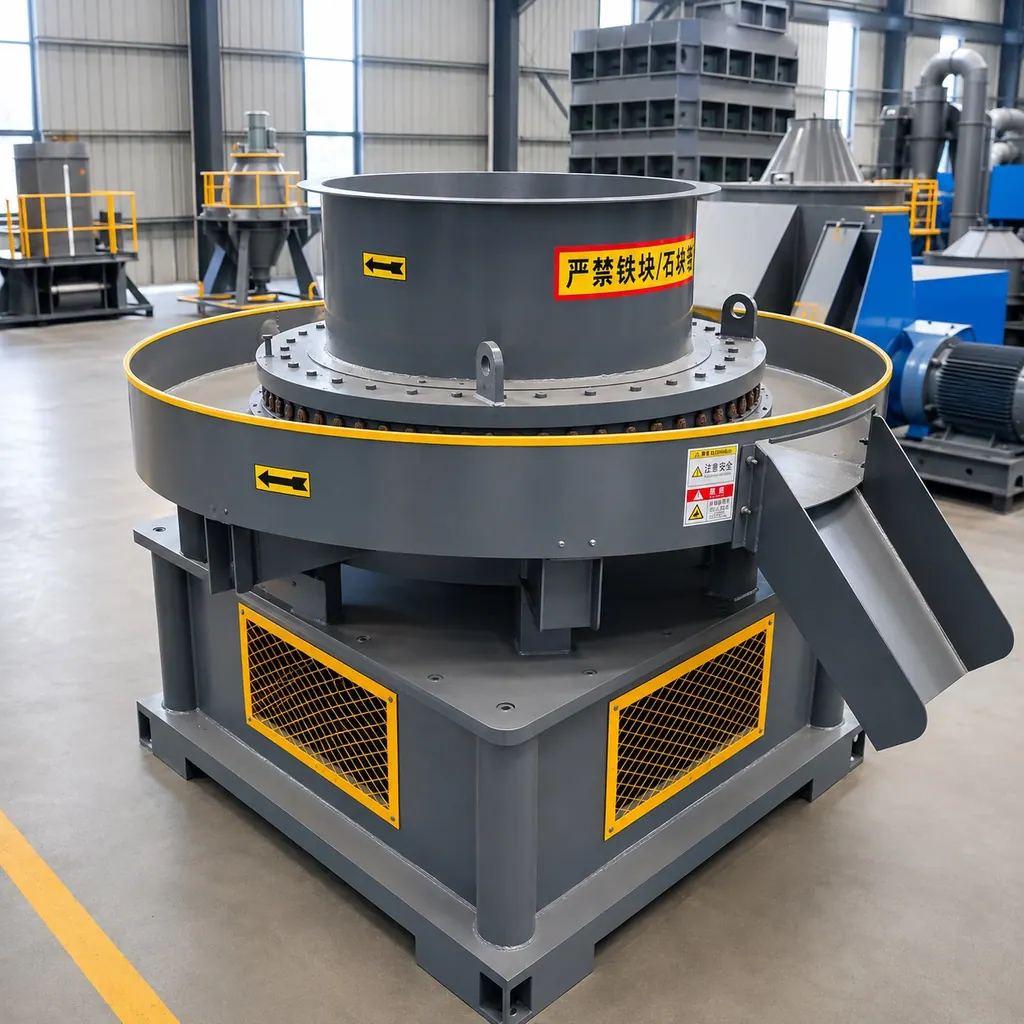
In aggregate processing, mining, and foundation pit clearance, high moisture content and sticky mud-stone mixtures frequently cause severe screen blinding and clogging in traditional vibrating screens, significantly reducing system throughput. The multi-shaft linkage Soil-Stone Separator (mud-stone separator) achieves continuous, highly efficient separation and grading of wet sticky materials through co-rotating multi-shafts and dynamic peeling actions of special-shaped discs.
Multi-Shaft Linkage Peeling and Continuous Anti-Clogging Principle
The core structure of the Soil-Stone Separator consists of multiple parallel transmission shafts fitted with special-shaped screen discs (such as polygonal or plum-blossom shapes). Upon entering the feed end, the shafts rotate co-directionally via the drive mechanism, causing the special-shaped discs to exert continuous lifting, forward propulsion, and intense tumbling actions on the mud-stone mixture. During this process, fine particles and loose soil fall rapidly into the lower collection hopper through the inter-shaft gaps, while oversized stones are continuously conveyed to the discharge outlet. Because the shafts and discs maintain constant dynamic rotation, sticky soil cannot adhere or accumulate on the screen surface, thoroughly eliminating screen blinding issues common in wet operating conditions.
Three Core Advantages in Wet and Sticky Material Screening
Compared to conventional vibrating screens and trommel screens, the Soil-Stone Separator exhibits distinct industrial advantages when processing high-moisture mud-stone mixtures:
• Self-Cleaning Anti-Clogging Function: The special-shaped discs form a dynamic self-cleaning structure during rotation. Paired with anti-scraping blades, they continuously peel off sticky clay for clog-free operation.
• Downstream Protection & Load Reduction: Removing mud and fine impurities prior to crushing significantly reduces feed mud content, effectively extending the service life of jaw crusher and impact crusher liners and blow bars.
• High Throughput & Low Energy Consumption: The multi-shaft independent drive architecture offers high transmission efficiency. Within the same footprint, its material passage capacity substantially outperforms heavy-duty vibrating screens.
Selection Parameter Guide for Soil-Stone Separators
Configuring the appropriate number of shafts, disc geometry, and screen gaps based on specific working conditions is key to ensuring screening efficiency:
1. Shaft Count & Screen Deck Length: Typically configured with 6 to 18 shafts. Larger feed volumes or higher mud-stripping purity requirements demand a greater number of shafts.
2. Screen Gap Configuration: Screen gaps can be flexibly adjusted between 20mm and 100mm, set according to the particle size requirements of downstream processes.
3. Disc Profile Selection: For high-viscosity mud and stone mixtures, multi-angle plum-blossom discs are preferred to enhance cutting and peeling forces; wave discs are suitable for medium-viscosity gravel.
4. Drive System Setup: For heavy-duty operations with large boulders, independent multi-motor gearbox drives are recommended to guarantee high torque output per shaft.
Typical Application Scenarios and Process Layout
Soil-Stone Separators are widely utilized in primary pre-screening for aggregate production lines, mud-stone stripping in excavation pits, overburden removal prior to open-pit mining, and primary sorting of construction and demolition waste. By placing the Soil-Stone Separator between the feeder and the primary crusher, soil and fine sand are screened out in advance. This not only improves the mud-content index of finished aggregates but also significantly reduces unnecessary crushing energy consumption.
FAQ: Wet and Sticky Material Screening
Q: Is water flushing required when handling clay with high moisture content? A: The Soil-Stone Separator relies on mechanical peeling to achieve dry mud-stone separation without additional water, eliminating downstream wastewater treatment costs.
Q: How do you address severe disc wear caused by large heavy rocks? A: Discs are cast from high-wear-resistant alloy steel with reinforced surface treatments. They feature a modular split design, allowing worn discs to be replaced individually to lower O&M costs.
Q: Can the screen gap spacing be adjusted at a later stage? A: Screen gaps can be adjusted by replacing shaft sleeves/spacers or modifying disc spacing, accommodating seasonal changes and raw material variations across different quarry sites.