
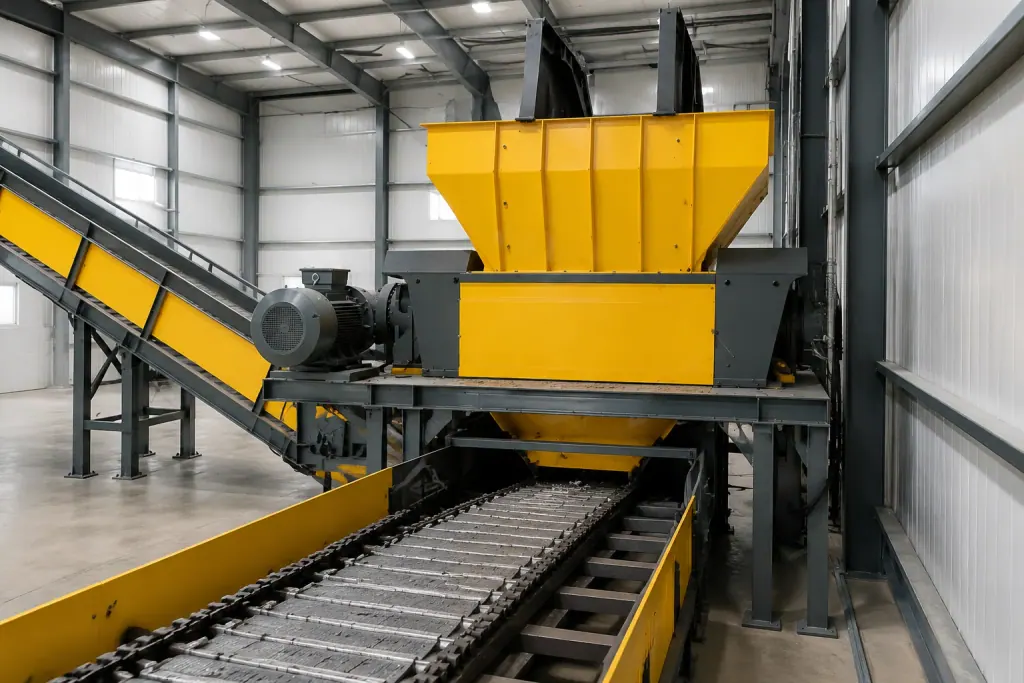
The Double-Shaft Shredder handles primary shredding in the Waste Tire Granule Line. Intermeshing special alloy blades mounted on twin rotors cut whole scrap tires into coarse rubber chips using shearing and compressive forces. Compared with older conventional units, this structure increases throughput per machine by more than 40%.
Procurement engineers often struggle to calculate gearbox torque margins and determine the right blade hook profile. Tire beads house thick, high-tensile steel wire rings, while the plies contain dense cords of fine wire. Equipment requires a heavy-duty bearing system paired with a low-speed, high-torque precision gearbox to force down these metal-rubber composites.
Blade thickness sets the strip width of primary chips directly, while hook tooth geometry dictates whether whole tires feed smoothly without slipping. Define the maximum diameter of incoming tires, check the acceptable feed size of downstream granulators, and configure the cutting chamber and drive train accordingly.
| Equipment / Component | Operating Condition & Configuration | Process Stage | Selection Criteria |
|---|---|---|---|
| Double-Shaft Shredder primary drive | High-torque precision gearbox with heavy-duty bearing system | Primary shredding of whole tires | Torque reserve based on transient shear strength of truck tire bead wires |
| Primary shredding rotor blades | Wide single-hook curved wear-resistant alloy blades | Whole large-diameter scrap tire feed | Enhanced bite to stop tires bouncing idly above cutter shafts |
| Secondary shredding rotor blades | Multi-hook wear-resistant alloy blades with counter-knives | Pre-cut rubber chunk feed | Higher cut frequency to control chip size and stop wire wrapping |
| Electrical control protection module | Automatic bidirectional reversing overload protection system | Anti-jam protection during primary shredding | Reversal release and overload trip thresholds set by motor current |
Tire Primary Shredding Load Characteristics and Double-Shaft Shredder Shear Torque Sizing
Passenger car tires have relatively soft carcasses that rebound easily during shredding. Truck and bus tires feature thick ply layers and heavy bead wires. Car tires tend to bounce on top of rotating cutters, whereas large truck tires exert sudden peak resistance on the main shafts the moment blade tips puncture the bead bundles.
Drive suitability on site is judged by motor current spikes as blade edges bite into tire beads. Sizing gearbox nominal torque solely for pure rubber tread leads to rotor stall and breaker trips when encountering thick bead rings. If feeds include whole un-debeaded tires, gearboxes must be selected for peak torque required to shear high-strength steel wires, with sufficient safety margin against shock loads.
Twin rotors rotate in opposite directions at differential speeds distributed by the gearbox. Staggered shaft speeds change stress points on material contact surfaces, preventing tires from riding idly on a single shaft and drawing rubber and bead wire into the cutting zone.
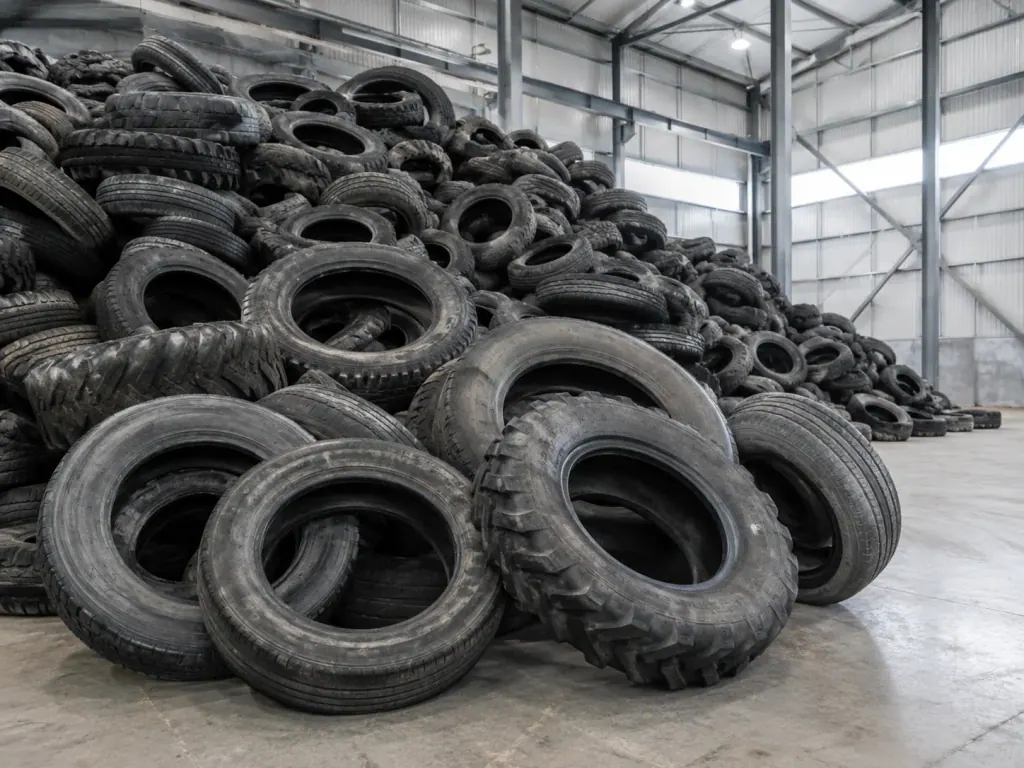
Wear-Resistant Alloy Blade Thickness and Hook Profiles: Impact on Rubber Chip Size
Inlet throat dimensions of secondary size reduction machinery determine required blade thickness on the primary Double-Shaft Shredder. Axial blade thickness equals chip output width. Thinner blades yield narrower rubber strips, but lower their section modulus, raising breakage risks against uncut heavy bead wires.
Hook tooth count depends on feed dimensions. Large-diameter whole truck tires require single-hook deep-curve teeth for aggressive draw-in, pulling round carcasses between the twin shafts. Pre-shredded rubber pieces feed better into multi-hook shallow teeth, providing higher contact frequency and fewer oversized slivers.
Blade metallurgy dictates wear replacement intervals. Shredders use wear-resistant alloy blades, with clearances between rotating cutting edges and stationary counter-knives aligned during assembly. Counter-knife tips sit close to rotor spacer rings, stripping tire cords and loose fine wires off shafts to avoid wire build-up inside bearing housings that causes friction heating and seizure.
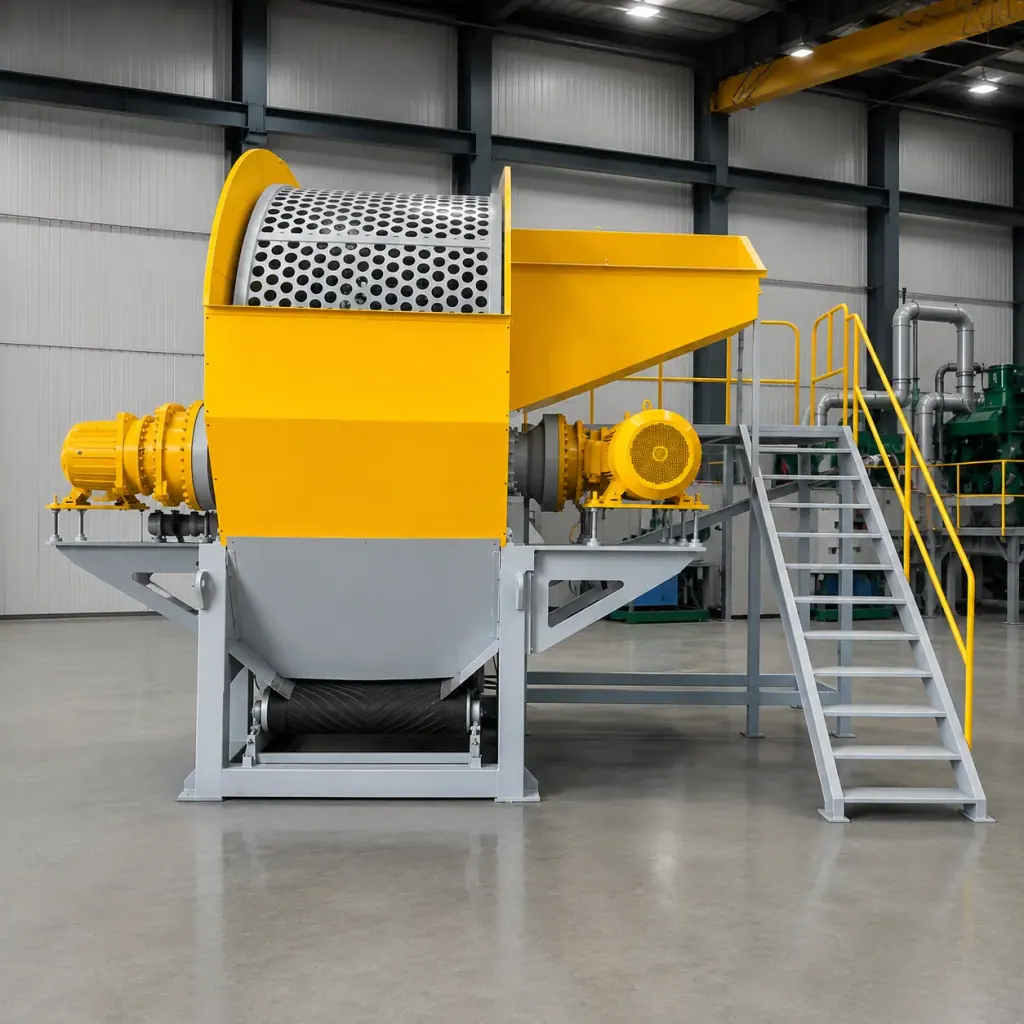
Low-Speed High-Torque Drive Train and Two-Way Automatic Anti-Jam Configuration
Scrap tire shredding often introduces rim fragments or oversized tramp metal. When uncrushable material wedges between rotating blades and counter-knives, shafts stop within milliseconds, directing all machine kinetic energy into gearbox teeth and motor shafts. Heavy-duty bearing assemblies and gearboxes require mechanical shock absorbers or shear pins to prevent rigid impact damage.
Control software reversal routines determine whether a stalled unit recovers without manual intervention. Responsiveness and logic of discharge reversal under overcurrent show system maturity. When motor current exceeds preset limits, controls cut forward power, reverse shaft rotation by a set angle to release material, and resume forward cutting.
If the drive fails to cut through after preset consecutive reverse attempts, the electrical system trips, locks out, and sounds an alarm to protect gear teeth and shafts from bending. Automatic reversal cycles minimize manual chamber cleanouts.
Machine in Action
FAQ
- Why is a Double-Shaft Shredder preferred for primary shredding in a Waste Tire Granule Line?
- The unit uses twin-rotor alloy blades for low-speed shearing and compression, cutting rubber and bead steel directly. It delivers over 40% higher throughput than conventional crushers, and low-speed operation reduces stalling from tramp metal.
- How should blade hook profiles be selected on a Double-Shaft Shredder?
- Selection depends on feed dimensions. Whole large-diameter tires require single-hook curved teeth for intake pull. Pre-cut rubber chunks require multi-hook teeth to raise cutting frequency and reduce output chip size.
- How is the drive train protected when uncuttable foreign objects jam the chamber?
- Heavy-duty bearing assemblies and precision gearboxes absorb sudden shock loads. Electrical controls monitor motor current, reversing rotors to reposition lodged objects and tripping off after consecutive failed cuts to protect gears and shafts.